
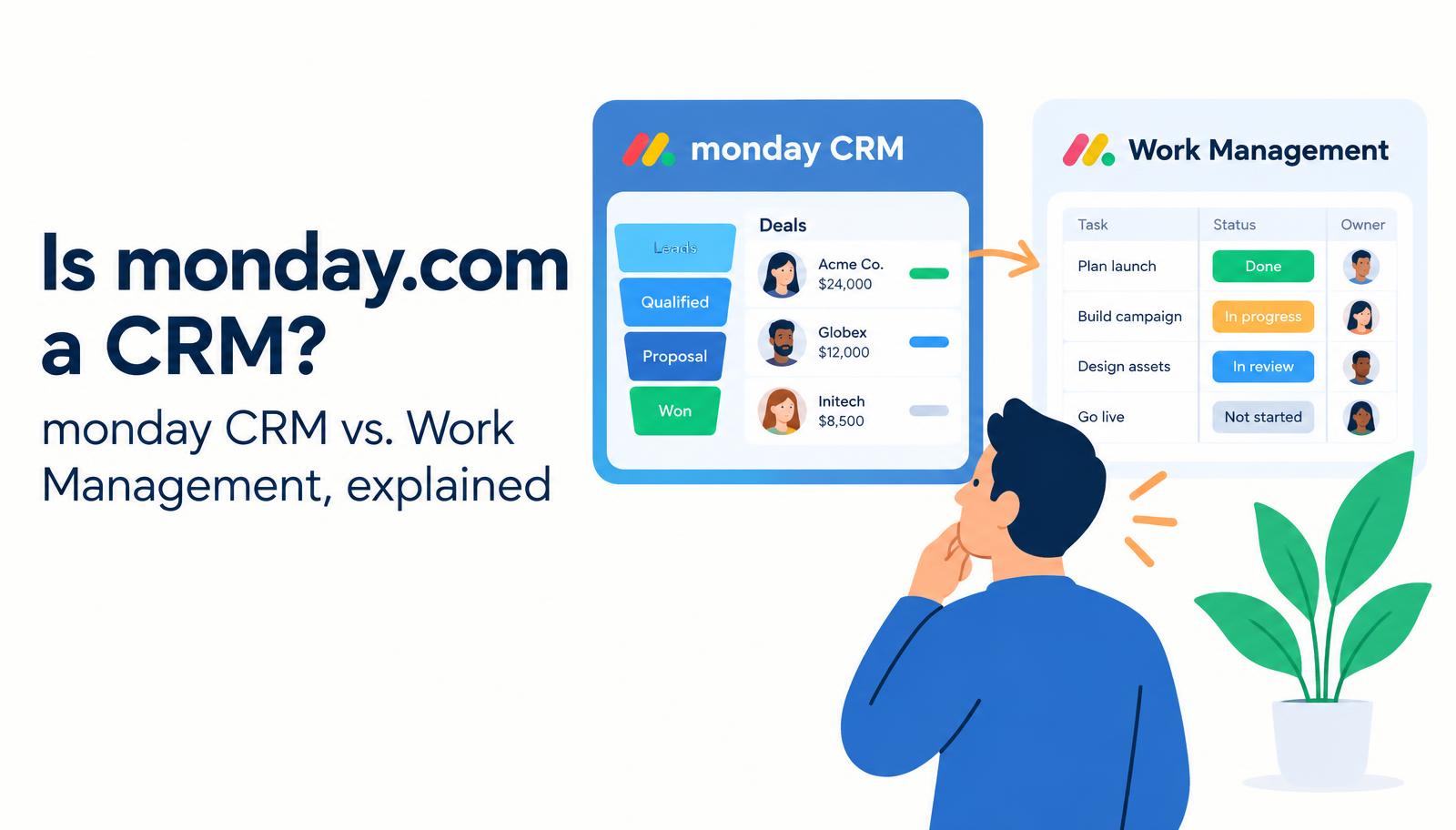
The answer to "is monday.com a CRM" is yes. monday.com provides an AI-native CRM, and it's called monday CRM. It's a separate product from monday.com Work Management, the boards most people picture when they say "monday.com," and since 2026 it has its own home at mondaycrm.ai. Work Management isn't a CRM.
You can track a pipeline in it, but it doesn't have the features that make a CRM worth paying for, which is why we start every build from how you actually sell.
monday CRM is a good fit for companies that want sales and delivery on one platform. Typically, when a client asks us to build their CRM in monday.com, we build it in monday CRM and connect it to the boards operations already uses.
Is monday.com A CRM?
monday.com is a leading project management solution. What most business leaders don’t know is that one of the products it sells is a CRM. It sells four standalone products: monday.com Work Management, monday CRM, monday.com dev and monday.com service.
So "is monday.com a CRM" has three answers, depending on which monday.com you mean. Most owners asking already run projects in monday.com and want to know if sales can live there too. That's usually the start of a conversation about what the system has to do.
- monday.com is the company and the platform everything runs on.
- monday.com Work Management is the original product: boards for projects and operations.
- [monday CRM](https://mondaycrm.ai/) is the sales product, bought and billed separately.
monday.com started as a work management platform and added products for sales, service and development teams. The CRM launched in 2022 as monday sales CRM. In 2026 it moved to mondaycrm.ai, which monday.com calls the dedicated home of monday CRM. New site, same company: your account, security and support still work the same way as the rest of monday.com. The move came with a heavy push into AI, and I've covered what monday.com's AI does once it's switched on.
What Actually Makes Software A CRM?
A CRM is a system where every contact, company and deal is a linked record, every conversation is attached to that record, and the pipeline can be reported on without someone rebuilding it in a spreadsheet every Friday. That's my test, and it's the one I'd hold any CRM to, monday.com or otherwise. If your leadership team can't pull the reports a CEO should be able to pull without asking, it isn't doing the job.
- Contacts, companies and deals are separate records that link to each other.
- Email and activity history land on the record automatically, not by copy-paste.
- Deals move through stages with values, and the pipeline is reportable.
- Duplicates get caught when leads come in.
- Sales can quote and hand a closed deal to delivery without anyone retyping it.
Here's how the two monday.com products score against that test, using monday.com's own feature comparison and the monday CRM plan page:
| The test | monday.com Work Management | monday CRM |
|---|---|---|
| Linked contacts, companies and deals | Possible, with connected boards you build yourself | Built in |
| Email history on the record | Not built in | Two-way Gmail and Outlook integration |
| Pipeline reporting and forecasting | Dashboards, but no sales forecasting or lead scoring | Deal-stage and funnel widgets, forecasting and lead scoring |
| Duplicate handling | Not built in | Duplicate management |
| Quotes and handoff to delivery | Not built in | Quotes and invoices, connected to Work Management boards |
By that test, monday CRM is a CRM. Work Management is a very good place to track one, and a very expensive place to rebuild one by hand.
What Does monday CRM Include That Work Management Doesn't?
The sales layer. The monday CRM features that matter are the ones Work Management doesn't have. Both products run on the same platform, so they look alike: boards, columns, automations, dashboards. Looking alike doesn't make them the same product. monday.com's own documentation lists features that exist only in monday CRM, and they're the ones a sales team feels by week two. Most of them show up in the cost of each plan, too.
- Capture: lead forms, data enrichment and duplicate management
- Communication: a shared email inbox, two-way email sync and email campaigns
- Pipeline and reporting: deal-stage and funnel widgets, a sales pipeline view and advanced CRM reporting
- Quoting: quotes and invoices
- AI: sales-specific agents and an AI Notetaker
monday.com is plain about the gap. Its own FAQ says Work Management lacks lead scoring, pipeline forecasting and sales automation, and that you can configure it as a CRM without those features. Plan limits matter too. monday CRM caps active contacts and deals at 1,000 on Basic, 10,000 on Standard and 100,000 on Pro, and mass emails and sequences start on Pro. For a 50 to 200 person company, that usually decides the plan before anything else does, and it's the first thing we check against your deal volume.
What Are The AI Agents In monday CRM?
monday CRM now ships agents built for sales work: Lea, the lead agent, plus lead sourcing, calling, pipeline monitor and meeting prep agents, custom agents and an AI Notetaker. monday.com launched its agent builder in September 2025 and put the first agents in monday CRM, aimed at sales development work. Think of each agent like a junior SDR on day one: capable, fast, and only as good as the instructions and records you hand it. It's the same reason we brief an agent the way we'd onboard a new hire.
That's the limit. An agent works off the data it's given. If contacts are duplicated across boards and email history isn't attached to the deal, the agent automates the mess. A clean CRM is the first item on what has to be true before monday.com's agents do useful work.
These sales agents also aren't the same thing as monday.com Agents, the platform-wide builder, or monday.com Sidekick, the assistant that works like Microsoft Copilot. If you're using monday.com as a CRM, the sales agents are the ones that touch your pipeline, and they're the ones we set up after the CRM is live.
Can You Use monday.com Work Management As A CRM?
You can track a sales pipeline in monday.com Work Management, and plenty of companies do. You're building a sales tracker, not a CRM. If you're a founder with one pipeline and a dozen open deals, a Work Management board with a CRM template is fine, and Work Management is the only monday.com product with a free plan. There's a real case for doing it yourself at that size.
Ready to put monday.com AI to work?
Book a free consultation with our certified monday AI team and leave with three recommendations you can act on.
A CRM template is a board layout, though, not the CRM product. It doesn't come with the monday CRM features a sales team relies on: email history on the record, duplicate catching, forecasting, lead scoring or quotes, because monday.com keeps those in monday CRM. Every one of those gaps becomes a manual step, and manual steps are where pipelines go stale. That's the point where owners start weighing an outside team against a full-time hire to keep it clean.
When a client asks us to build their CRM, we build it in monday CRM, for the same reason we'd tell a Salesforce shop when to stay put: the right product beats the clever workaround. It's a separate product for a reason, and rebuilding its features on Work Management boards costs more in build hours than the seats do.
If your team already lives in monday.com for projects, don't rebuild a CRM on boards. Add the CRM, connect it to the boards your operations team uses, and start from a proof of concept you can see working.
Is monday CRM A Good CRM?
For a company that wants sales, onboarding and delivery on one platform, yes. For a company whose funnel runs on marketing automation, or that needs enterprise-grade forecasting, there are better fits. I'd rather say that up front than find out in month six, the same way we tell clients when to stay on HubSpot.
Who monday CRM Fits
If you're weighing monday.com as a CRM, this is the profile where it earns its place, and it's close to the companies we're built to work with.
- Services companies where the deal hands off to a project. monday.com built the CRM and Work Management to work together under one account, so a closed deal becomes a delivery board without retyping.
- Teams already on monday.com Work Management. The CRM sits on the same account and the same platform.
- Owner-led companies that want to change the pipeline themselves, without waiting on an admin or a developer.
That last group is most of who we work with, and it's why our builds lean on components we reuse across clients instead of custom code.
Recently, we set up monday CRM for a construction company where we had their pipeline stages built around how their estimators actually quote, inbound leads attributed to source and routed to the right rep and closed jobs handed to the project team on the same platform.
When monday.com Is The Wrong CRM
- Marketing automation is the center of your funnel. Multi-step nurture, scoring across channels and attribution are where HubSpot is usually the better fit.
- Your sales motion is enterprise-complex. Territories, multi-currency deals, configure-price-quote and heavy forecasting point to Salesforce, and here's where Salesforce is the right answer and where it isn't.
- You're a team of one or two. Paid plans start at three seats.
We're a partner for monday.com, HubSpot and Salesforce, and we tell clients to pick one of the other two when that's the right answer. That's easier to say when you aren't paid on only one platform's seats, and it's part of how we scope every build.
Do You Have To Switch Products If You Already Use monday.com?
No. You add monday CRM to your existing monday.com account, and your operations team stays on Work Management. The products are bought and billed separately: each can sit on its own plan with its own seat count, but they have to share a billing cycle, monthly or yearly. Seats come in buckets, three to start, then multiples of five. Only the people who sell need CRM seats. Everyone else can still see the numbers on a dashboard that pulls straight from the CRM.
One change catches longtime customers. When monday.com separated its product pricing in 2024, new CRM seats stopped including Work Management access, and early buyers' bundled discounts end at their first 2026 renewal. If you bought early, check that date. We've laid out the seat math, including whether you need both products.
How Fractional Ops Builds monday CRM
We build monday CRM around how your company sells and delivers, then connect it to the Work Management boards your operations team already uses. CRM first, then the handoff to delivery, then the agents, in that order. Fixed scope, and a price on the page for each package.
Fractional Ops is a top 10 monday.com partner. We won the 2026 monday.com Partners Global Hackathon, and we're also HubSpot and Salesforce partners. The people designing your system are former COOs, CROs and CFOs of 8- and 9-figure US companies, which is who you'll actually be working with.
Frequently Asked Questions
Is monday CRM free?
No. monday CRM has no free plan, only a 14-day trial, and paid plans start at three seats. The free plan monday.com offers is for Work Management only, which covers projects, not monday CRM features like email sync or forecasting. If you're pricing it out, here's what the paid plans cost once the trial ends.
Is monday.com a project management tool or a CRM?
monday.com is both, as separate products. monday.com Work Management handles projects and operations, and monday CRM handles sales. They share an account and a platform, so a closed deal in the CRM can hand off to a project board without retyping. Most of the companies we work with run both, and it's why we scope the handoff as part of the build.
What's the difference between monday sales CRM and monday CRM?
They're the same product under a new name. monday CRM launched as monday sales CRM in 2022, was renamed monday CRM, and in 2026 moved to its own site at mondaycrm.ai. It's still part of monday.com. If you're deciding whether to move onto it, compare ongoing support on a monthly plan with a one-off build.
Is monday CRM HIPAA compliant?
monday CRM lists HIPAA compliance on its Ultimate plan, alongside advanced security, governance and permissions features. The lower plans don't list it. If you handle protected health information, budget for Ultimate from the start and confirm the terms with monday.com before you move any records. It's one of the questions we settle before a build starts.

Corey Peck
Corey Peck is the Founder & CEO of Fractional Ops, a leading monday.com AI Certified Channel Partner. Since 2012, he has grown teams of employees and global Creators from 2 to over 7,200, while leading organizations he’s co-founded to become Great Place to Work® Certified™ three years in a row.