
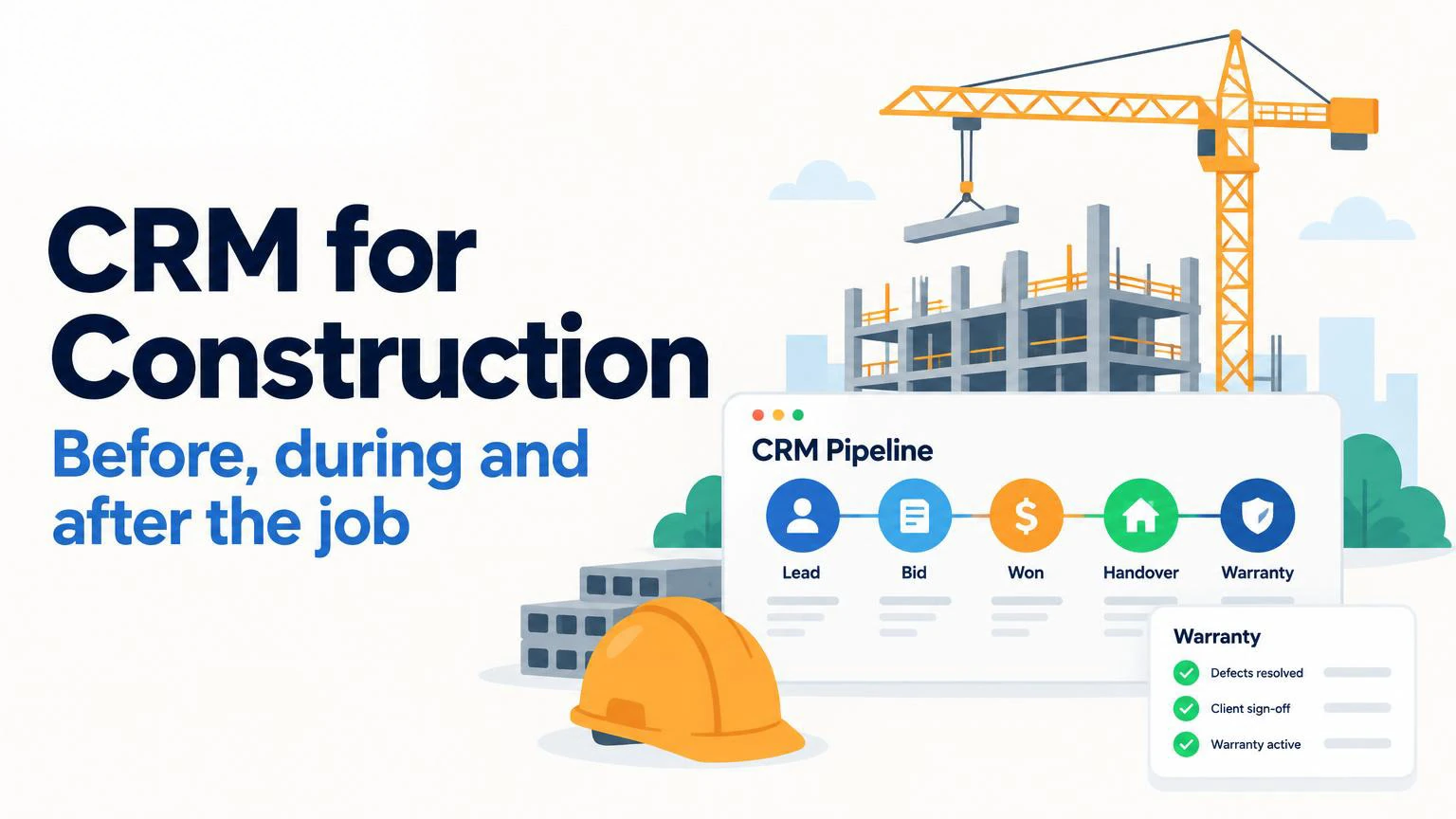
A CRM for the construction industry should cover the whole relationship, not just the pursuit. That means outbound to developers and general contractors, inbound leads and where they came from, scoping, handover, warranty claims, service requests, and the repeat and referral work that follows. Most construction CRM software stops at contract award, which is exactly where the next job starts.
In most construction companies I walk into, the CRM was set up once, nobody owns it, and the weekly numbers are wrong. A construction CRM won't fix a sales process nobody has written down. It will make one visible, which is why we build the system and the process together.
What Is A Construction CRM, And What Isn't It?
A construction CRM tracks your relationships and revenue: the companies and people you work with, the work you're pursuing, what you've bid, who owes whom a reply, and what customers need after the job is handed over.
It's easy to confuse with the tools that run the job itself. When owners search for construction management solutions, most of what comes back is project software for schedules, RFIs, daily logs and cost. That's construction management software. It runs the project. A construction CRM runs everything around the project, and a CRM for construction companies is where the revenue side of the business lives.
CRM Vs Construction Management Software
Most companies need both, and the trouble starts when one is expected to do the other's job. Buying more construction management solutions won't fix a CRM problem, and the reverse is just as true. The CRM should hand scope, contacts and commitments to the project tool at award, then take the customer back at closeout. Neither tool should be pretending to be the other.
Is Procore A CRM?
It has one now. Procore sells a construction CRM within its platform that covers lead capture, bid tracking, owner-and-developer relationship history, and moving won bids into active projects. That's a reasonable pre-award tool. Its page says nothing about warranty claims or service requests, and that's the gap the rest of this article is about. It's also the gap that shows up when we compare platforms for clients.
Why Do Construction Companies Stop Trusting Their CRM?
Construction selling is long-cycle, relationship-heavy and mostly fed by referrals and repeat clients. A construction CRM has to be built around that. One built like a software company's sales pipeline doesn't fit, and the people asked to keep it current notice that first.
The pattern I see most often looks like this. Someone junior sets the CRM up. Nobody owns it after that. The salespeople are asked to keep it current on top of selling, and they choose selling, which is the right call. Then the weekly leadership meeting runs on numbers everyone in the room knows are wrong.
When the CRM is wrong, lead management collapses to whatever's hottest. Nurture stops. Re-engagement stops. Past clients hear from you when they call with a problem. It's a management problem the CRM makes visible, and it's why the seven numbers a CEO should be able to pull without asking usually can't be pulled.
We worked with a construction company doing commercial and residential work whose CRM a junior marketing coordinator set up, and nobody owned it after that. Every week the leadership team reviewed numbers that were missing or wrong. Their two salespeople were handed admin on top of selling, so they worked the hottest leads and let everything else go quiet. Today the weekly leadership meeting runs straight off the CRM, and nobody rebuilds the numbers in a spreadsheet beforehand.
Which Kind Of Construction CRM Fits A 50–200 Person Company?
No single CRM is best for construction. Four kinds of construction CRM software exist, and each one stops at a different point. The right CRM for contractors depends on how your company sells and what you need the system to do after you sign the contract.
| Type | Examples | Built For | Where It Stops | Fits When |
|---|---|---|---|---|
| Construction-specific CRM | Buildr, JobTread | RFP intake, precon and business development | Contract award | Pursuit volume is high and your process matches the vendor's |
| All-in-one construction platform | Buildertrend, Procore | Running projects, with a CRM attached | Warranty and service are thin or missing | You already run projects in that platform |
| Field service platform | Jobber, JobNimbus | Residential trades and quick jobs | Long-cycle commercial pursuits | Jobs are small, fast and high-volume |
| General-purpose CRM, configured | monday CRM, HubSpot, Salesforce | Whatever workflow gets built | Nothing, if it's built properly | You need sales, warranty and service in one place |
Read the last row carefully, because it cuts both ways. A general-purpose CRM is the most flexible option and the one most likely to be set up badly. Construction-specific CRMs ship with the right fields on day one and stop exactly where the vendor stopped building. We've written separately about how monday holds up against HubSpot for an operations-led team.
Specialty trades sit somewhere in between. An electrical or mechanical contractor bidding commercial work behaves like a general contractor. One running service calls behaves like a field service company. Pick the CRM for contractors that matches how you win work, not what your trade is called. It's the first question we ask every new client.
What Should A Construction CRM Run, From First Call To Warranty Claim?
This is where most construction CRM software stops short. The list below outlines what a construction CRM should cover across the whole job, in the order the customer experiences it. Most of what follows sits after the contract is signed, and none of the top-ranking guides to choosing a CRM for contractors cover it.
1. Outbound To Developers, Owners And General Contractors
Referrals are where most construction work starts, and they're the first thing to dry up in a slow year. Outbound is how you stop depending on them. That means a defined list of developers, property managers, owners, and GCs, sequences that run every week whether anyone remembers or not, and a sales team that only steps in when someone replies.
The CRM's job is to keep it all in one place. Every sequence, reply and booked meeting lands in the same pipeline the sales team works, so leadership can see which source produced which job. Lead generation fills the top of that pipeline. Lead management is what happens to a lead once it exists, and a company needs both working before either pays off. It's the kind of work we take on as a single project.
We work with one construction firm that had relied on inbound and referrals for years, and both were shrinking. Revenue followed. We built proactive outbound campaigns to developers, property managers, and general contractors, ran them for the client, and synced every reply and booked meeting into their Monday boards. New conversations now start every week, and the pipeline no longer waits on the phone to ring.
Different industry, same problem: for a commercial printing company, the outbound we run across email and LinkedIn produces a consistent 33 meetings a month.
2. Inbound Leads And Where They Came From
Inbound is lead management at its most basic. Every web form, phone call and referral gets logged with its source and routed to an owner the same day. Nothing sits in a shared inbox waiting for someone to notice it.
The point isn't more leads. It's knowing which channel produced signed work, so the next dollar of marketing goes to the channel that pays. That number belongs on the dashboard your leadership team reviews every week, next to win rate and pipeline coverage.
3. Go/no-go And Project Scoping
Estimating hours are the scarcest resource in a construction sales process. Every bid you shouldn't have chased costs an estimator days that could have gone to work you'd actually win. A go/no-go step in the CRM, with the criteria written down, stops the team bidding on hope.
Scoping notes live on the deal record from the first site visit, so the estimator doesn't re-ask the customer what the salesperson already heard. When an RFP comes in, it becomes a deal with an owner and a decision date, not an attachment in someone's email.
4. Handover From Sales To The Project Team
What was promised in the sale has to reach the superintendent. The CRM passes scope, contacts and commitments to the project tool at award, so the field team starts with what the customer was told rather than what someone remembers.
Closeout feeds the other way. The completion date goes back into the CRM and starts the warranty clock, the re-engagement schedule and the request for a referral.
5. Warranty Claims
This is the claim no ranking page makes, and it's the one that matters most to repeat business. To be clear about scope: I don't mean the warranty product itself, such as a home builder warranty policy. I mean the workflow. How a claim gets logged, who owns it, how fast the customer hears back, and when it's closed.
Ready to put monday.com AI to work?
Book a free consultation with our certified monday AI team and leave with three recommendations you can act on.
In most construction companies, warranty claims arrive by email to whoever the customer knows. That's often a superintendent on another job site who can't reply for days. Nobody has a list of what's open. Leadership finds out about a slow claim when the customer complains, or when the referral that should have followed never comes.
The fix is a single intake, through a form or one shared address, that logs every claim against the customer and the project, assigns an owner, acknowledges the customer automatically and tracks the claim to close. A warranty claim is a repeat-work conversation. Handled slowly, it costs you the next job.
For example, one client had customers email warranty claims to whoever they knew on the team, usually someone on a job site who couldn't reply for days. There was no list of open claims anywhere. We built a single intake that logs every claim in monday CRM against the customer and project, assigns an owner and tracks it to close. Customers now get an acknowledgment the same day, and leadership can see every open claim on one board.
6. Customer Service Requests
Questions after handover follow the same pattern as warranty claims, and they deserve the same mechanism. A homeowner asking about a finish, or a property manager asking about a maintenance schedule, goes into a queue with an owner, not into one person's inbox.
Service requests are also the cheapest signal you'll get about a customer's next project. When they're logged against the account, the sales team can see who's been in touch and why before they call. That's the kind of context monday's built-in agents can summarize, but only if the requests were captured in the first place.
7. Repeat Work And Referrals
Past customers get re-engagement on a schedule, not when someone happens to remember them. A note at six months, a check-in before the warranty period ends, a request for a referral when the customer is happiest. All of it is set at closeout and runs without anyone remembering to do it.
This is the nurture most construction sales teams stop doing first, because it never feels urgent. It's also where referrals come from. Set the re-engagement reminder at closeout, not a year later. It's one of the first things an experienced monday partner will ask about.
Why Don't The Usual Fixes Work?
By the time a construction company calls us, it has usually tried at least two of the following. This is the point where owners go from frustrated to cynical about the whole idea of a CRM. Push through, because each of these fails for a specific reason.
An SEO agency. More inbound flows into a CRM nobody updates. The leads go quiet faster, and the agency's report still looks good.
A junior marketing coordinator. They can set the CRM up once. They don't have the authority to make a sales team use it, and they shouldn't be asked to.
A marketing consultant. You get a strategy. You don't get the system that runs it, or anyone to keep that system current.
Handing CRM admin to the salespeople. They'll sell or they'll update. With a two-person team, they'll sell, and they should. Don't hand CRM admin to the people you most need selling.
An outside team isn't free either. It takes leadership time in the first weeks to agree on stages, definitions and who owns what, and no outside partner can make those decisions for you. There's a short list of what companies do instead of hiring a full RevOps team, and most of the options work only once those decisions are made.
What Has To Be True Before A Construction CRM Works?
No CRM for construction survives without four basics in place. They're not technical, which is why people skip them.
One owner for the data. Not the salespeople, and not whoever set it up. One person or one outside team is accountable for the CRM being right every week.
The leadership meeting runs from the CRM. If someone rebuilds the numbers in a spreadsheet on Monday morning, the CRM has already lost. Pipeline, win rate, open warranty claims and lead sources should come straight from the system the team works in.
Logging from a job site takes under a minute. Superintendents and project managers will log a site visit or a customer request from their phone if it's fast. They won't if it's a form with twenty fields.
The process is in the software, not only in the binder. That applies to the whole construction sales process, and it's where EOS companies get stuck. EOS gets the core processes documented, but the steps live in a binder, not in the software the team opens every day. Too many small steps and too much data entry, and people stop following them.
Should You Configure monday CRM Or Buy Construction CRM Software?
Buy construction-specific software when your process matches the vendor's and you don't need warranty or service workflows in the same system. Some companies fit that exactly, and for them it's the faster path.
Configure a general platform like monday CRM as your CRM for construction when you need sales, warranty and service in one place, or when the business already runs on monday boards. You get a system that matches how you work. You also take on the risk that it's built badly, which is the risk most construction companies are already living with. That trade-off is the whole reason an outside build team exists.
Compare the cost to payroll, not to other software. The license is the smallest line. The real costs are estimator hours spent on bids that should have been a no-go, and a superintendent answering warranty emails instead of running a job. We've laid out the seat math and the costs nobody lists separately.
You also don't have to switch to fix it. Most of the work in a broken construction CRM is in how it was set up, not which brand of construction CRM software it is. Switching platforms with the same setup gives you the same problems in a new interface, which is what we tell clients weighing a move to Salesforce.
What Changed In 2026
AI agents now ship inside the CRM itself. In monday, that means agents that can triage incoming requests, draft follow-ups and summarize an account before a call. They're useful on top of clean records and useless on top of the records most construction companies have today. We've covered what monday's AI layer can and can't do yet in detail.
How Fast Can A CRM For A Construction Company Go Live?
Faster than most owners expect. For the contractor in this article, we deployed a pre-built CRM app and had it running the same week, with outbound and warranty intake built on top. The same-week start mattered to them, because they'd already spent months on fixes that didn't work.
Live isn't the same as trusted, though. Plan on the first few weeks being correction: records cleaned up, stages argued over, fields added and removed. The leadership meeting starts running from the CRM once those weeks are done, not on day one. If you want to see how that work is scoped, this is how we price a single project.
Bring Your Con
We're a team of former COOs, CROs and CFOs of 8- and 9-figure US companies, and we build revenue systems inside CRMs for businesses that don't have a RevOps team and don't want to hire one. One of the builds we do is a CRM for construction companies that runs from first outbound touch to closed warranty claim.
Book a session and get up to 5 hours of hands-on support. You'll leave with three recommendations for your CRM, whether you work with us or not. Start with how we work.
Frequently Asked Questions
What is the best CRM for builders?
The best CRM for builders, or any CRM for contractors, depends on what it has to run after the contract is signed. Construction CRM software built for general contractors suits high-volume bidding. All-in-one platforms such as Buildertrend suit builders who already run projects there. A configured platform like monday CRM suits builders who need sales, warranty and service in one place. We explain how monday compares in our partner's view of monday CRM against HubSpot.
What is CRM in construction?
CRM in construction is the system a construction company uses to track relationships and revenue: the companies and contacts it works with, the work it pursues and bids on, and what customers need after handover. It's separate from construction management software, which runs schedules, RFIs and costs on the job itself. A CRM for the construction industry also has to cover warranty and service work. For what it should report, see the numbers every executive dashboard needs.
Is Procore a CRM?
Procore offers a construction CRM inside its platform, covering lead capture, bid tracking, owner and developer relationships, and moving won bids into projects. Its own product page doesn't mention warranty claims or service requests, so most companies running Procore still need a separate CRM for construction warranty and service work. A comparison of how the big CRM platforms handle that helps narrow the choice.
Can a CRM track construction warranty claims?
A CRM can track construction warranty claims, but not by default. It needs a single intake, a link from each claim to the customer and project, an owner, an automatic acknowledgment, and a status that leadership can see. Built into a CRM for construction companies on monday, that turns a pile of emails, from punch-list items to home builder warranty claims, into one board of open claims. It's a standard part of what we build for construction clients.
Do small construction companies need a CRM?
Small construction companies need a CRM once more than one person sells, or once referrals slow down and nobody can say where the next job is coming from. Spreadsheet lead management works for one salesperson. It stops working the first time two people call the same developer. The question is usually who will keep it current, which is covered in the options short of a full-time hire.
How long does it take to set up a CRM for a construction company?
Setting up a CRM for a construction company can take days with a pre-built app, and our construction client was running the same week. Trusting the data takes longer, usually a few weeks of correction while stages and definitions settle. The timeline depends more on how quickly leadership makes decisions than on the software. Here's how a single project is scoped and priced.
How much does a construction CRM cost?
A construction CRM costs seats, setup and the ongoing time of whoever owns it. The license is usually the smallest of the three. The larger costs are estimator hours lost to poor bid decisions and field staff answering customer emails. For monday specifically, why the license is the smallest line breaks down seat tiers and the costs vendors leave out.
Can monday CRM work for a construction company that runs EOS?
monday CRM works for a construction company that runs EOS when it feeds the tools the leadership team already uses. Synced to Ninety, the CRM fills the Scorecard before each Level 10 Meeting, so the numbers come from the same records the sales team works in. It's one of the questions worth asking when choosing a monday.com partner with revenue-system experience.

Corey Peck
Corey Peck is the Founder & CEO of Fractional Ops, a leading monday.com AI Certified Channel Partner. Since 2012, he has grown teams of employees and global Creators from 2 to over 7,200, while leading organizations he’s co-founded to become Great Place to Work® Certified™ three years in a row.