
The Short Version
A monday.com partner is a company certified by monday.com to sell its licenses, implement it, or build apps on it. Most owners pick one by tier, and that's where it goes wrong. On monday.com's standard path, a partner's tier mostly measures how much license revenue it has sold and kept. It says little about how well it builds, which is why we start every engagement with how you actually sell.
For an owner-led company of 50 to 200 people, three things matter more than the badge: a partner who has run the function you're fixing, builds around how you sell, and prices the work before it starts. That's the partner Fractional Ops was built to be.
What Is A monday.com Partner?
A monday.com partner is a company certified by monday.com to sell, implement or extend the platform. monday.com's partner program splits into three paths. Solution partners sell licenses and implement. Service partners deliver professional services such as onboarding, training and custom workflows. Tech partners build apps and integrations for the marketplace. Plenty of firms work across more than one, and most of what owners hire us for is implementation.
Watch the labels. The app marketplace runs its own Bronze-to-Platinum ladder, set by app revenue from $5K to $1M a year, so a "Platinum" app developer isn't a Platinum implementer. Type, tier and badge also mean different things. Type is what a partner does. Tier is where it stands in monday.com's program. Badges are where it has specialized. Buyers read all three as one ranking. They aren't.
What Do monday.com Partner Tiers Mean?
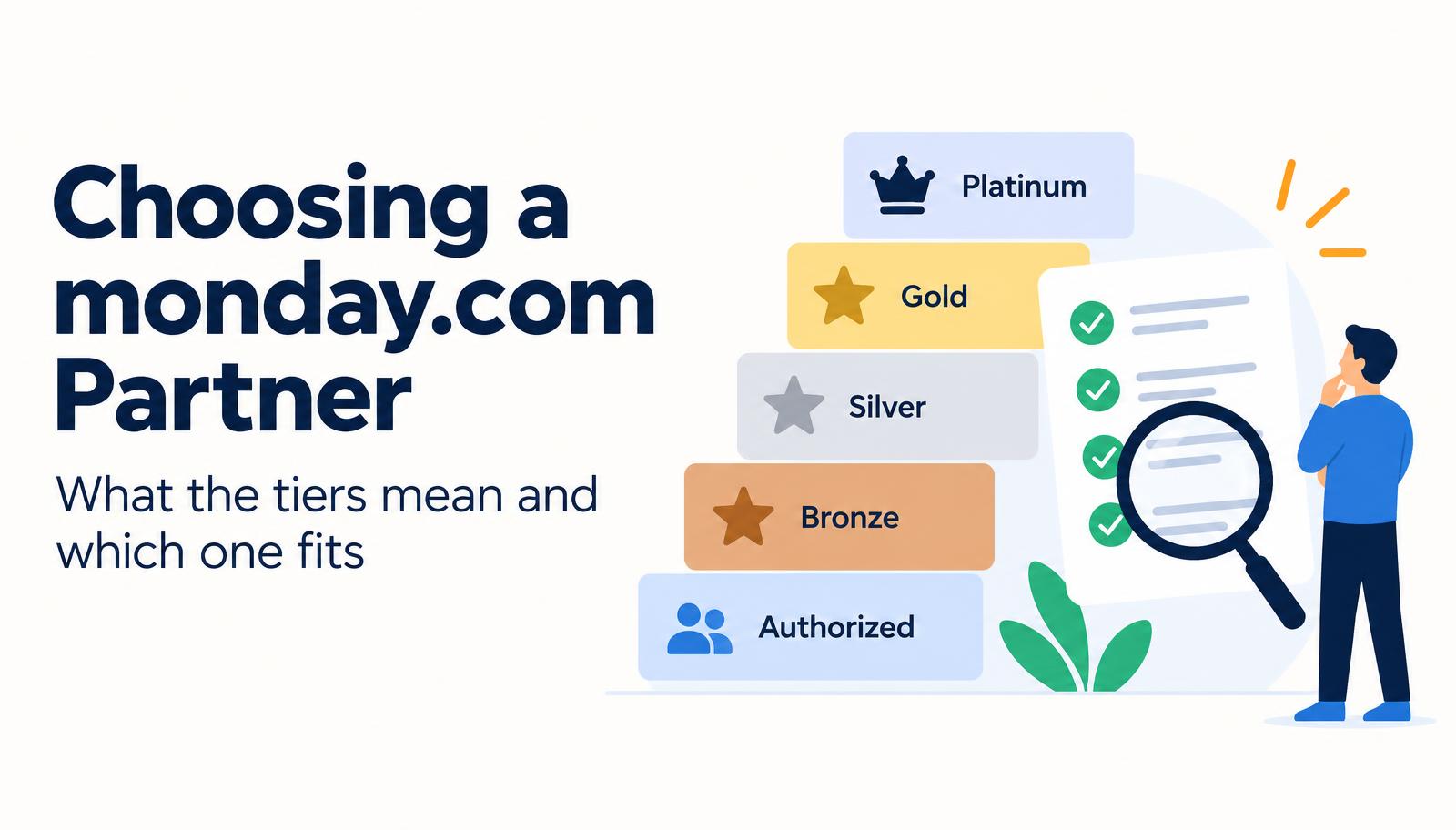
monday.com ranks Solution partners in five tiers: Authorized, Bronze, Silver, Gold and Platinum. On the standard sales path, a partner climbs by selling monday.com licenses and keeping customers renewed. These are the thresholds in monday.com's Solution partner program guide:
| **Tier** | **Total license ARR** | **Partner-sourced new ARR** | **Retention (GDR, North America/UK/ANZ)** | **Certifications** |
|---|---|---|---|---|
| Authorized | — | — | — | 1 sales |
| Bronze | $30K | $12K | — | 1 sales |
| Silver | $60K | $12K | 85% | 2 sales, 1 CSM |
| Gold | $300K | $60K | 88% | 3 sales, 2 CSM, 1 AM, 1 marketing |
| Platinum | $750K | $120K | 90% | 5 sales, 3 CSM, 2 AM, 1 marketing |
Partners in North America, the UK and Australia/New Zealand can also reach Gold or Platinum through delivered work instead:
| **Tier** | **Projects or hours per year** | **Customer satisfaction (CSAT)** | **Partner-sourced new ARR** |
|---|---|---|---|
| Gold | 40 projects or 3,000 hours | 4.7 out of 5, min. 50% response | $35K |
| Platinum | 70 projects or 5,000 hours | 4.7 out of 5, min. 50% response | $75K |
Think of a partner tier like a car dealer's sales award. It tells you the dealer moves a lot of cars. It doesn't tell you who's under the hood. Higher tiers do earn real access: Platinum partners get first priority on monday.com's leads, and from Gold up monday.com's own customer success managers work alongside the partner's. That's worth knowing before you weigh a monday.com consultant on anything else.
Does A Higher Partner Tier Mean A Better Implementation?
Not on its own. On the sales path, a partner tier tells you a firm sells and retains a lot of licenses. That's useful, and it says nothing direct about whether the pipeline they build will still be accurate in month six. The most useful number in that table is retention. A partner keeping 85–90% of its license revenue has customers who kept using what was built.
So ask which path the partner tier came from. Then ask who on the team holds the certifications. Certifications belong to people and tiers belong to companies, and the certified consultant on the sales call isn't always the one doing your build. Those are the questions a partner directory can't answer for you.
A higher partner tier does buy something real: a bigger certified bench and a direct line into monday.com. It's the same trade-off owners weigh between an outside team and a full-time hire. When that bench matters, it matters a lot. I'll get to when further down.
What Do The Advanced Delivery Partner And Specialist Badges Tell You?
The Advanced Delivery Partner (ADP) badge is the closest thing monday.com has to a delivery credential. The product specialist badges mostly measure how much of a product a partner has sold. Here's what each requires, from the same program guide:
| **Badge** | **What it requires** | **What it tells a buyer** |
|---|---|---|
| Advanced Delivery Partner | 70 projects (10+ hours each) or 5,000 hours a year, CSAT 4.7 out of 5 | Volume of delivered work and satisfied customers |
| monday CRM specialist | 10 Enterprise CRM deals, $200K in CRM ARR | Enterprise CRM sales volume |
| monday Service specialist | 5 Enterprise Service deals, $80K ARR | Enterprise Service sales volume |
| AI specialist | AI certification, $30K AI ARR, 25% AI attach rate | AI license sales |
| AI Genius | AI certification, $100K AI ARR, 50% AI attach rate | More AI license sales |
The CRM badge shows why this matters at 50 to 200 people. Ten enterprise CRM deals tells you a partner sells to large accounts. It doesn't tell you they can build a monday CRM pipeline for five reps and an owner who still closes the biggest deals, or the reports that owner needs on a Monday morning.
Ready to put monday.com AI to work?
Book a free consultation with our certified monday AI team and leave with three recommendations you can act on.
The AI badges measure AI license sales, not agent-building skill, and monday.com says the AI specialist badge becomes a Platinum requirement in 2027. If you want monday Agents doing real work, ask to see one running in a live account. A badge won't show you what has to be true before an agent does anything useful.
How Do You Find A monday.com Partner?
Start in go-to-partners, monday.com's official directory of monday partners. It replaced the Expert Catalog and Partner Directory, and you can filter by location, services, industry, product and language, or answer a few questions and let its AI matchmaker suggest partners. It's a decent shortlist tool and a poor substitute for seeing a partner build something in your own account.
The matchmaker turns your answers into a "Live Brief" and shares it with the partner you pick, so write it the way you'd brief a new hire. Profiles show verified customer reviews. Read the ones from companies your size. If you'd rather not write the brief yourself, a Scoping Sprint produces one you keep.
One more label to check. A website that says "monday.com partner" may belong to an Authorized or Bronze firm, because monday.com lets partners use the title once onboarding and certifications are done. A go-to-partners listing starts at Silver. The directory is the version you can verify.
What Kind Of monday.com Partner Fits A 50–200 Person, Owner-led Company?
One that has run the function you're fixing, builds around how you sell, and tells you the price before it starts. At this size the owner still sits where sales, operations and delivery meet. There's no RevOps team to translate, and usually no plan to hire one.
- They've run the job. A partner who has carried a number or run operations designs stages and dashboards that hold up after month one.
- They build revenue systems, not boards. Pipeline stages in monday CRM, lead routing, the handoff to delivery, and the dashboard leadership actually trusts.
- They price it up front and can say no. Fixed scope, published prices, and a partner willing to tell you fewer seats or a lower plan will do.
If you're five people with one pipeline, skip the partner. A good template and a focused weekend will get you most of the way, and I've laid out when doing it yourself is the better call.
We worked with an 80+ person manufacturing company that ran EOS but had no way to get its numbers into monday.com or hold people accountable to them. The process lived in the binder, not in the software the team opened every day. We connected a monday Agent to a monday Vibe scorecard through the ninety.io MCP. The scorecard now fills from the same records the team already works in.
When Should You Choose A Bigger Partner Instead?
When the rollout is enterprise-scale. Hundreds of seats across departments, monday Service running a large support organization, regulated or government work, or delivery needed across several time zones at once. In those cases a Platinum or ADP monday.com partner's bench and its direct line into monday.com are worth paying for. I'd tell you that on the first call, the same way we tell clients when monday isn't the right CRM.
Why Do Companies Choose Fractional Ops As Their monday.com Partner?
Because the people designing the system have run sales, operations and finance in companies like theirs. Our team includes former COOs, CROs and CFOs of 8- and 9-figure US companies. We've completed 65+ mid-size implementations and built 50+ CRM and revenue systems, and most go live in about 90 days. You can see the components we reuse across builds.
On the monday.com side, we're a Silver Channel Partner, winner of the 2026 monday Partners Global Hackathon for Most Creative Solution, and recognized as the fastest-growing channel partner globally. The whole team is monday AI Level 2 certified, alongside outbound sales, advanced workflows and work management certifications. We're also HubSpot and Salesforce solution partners, so we'll say so when monday is the wrong call, as we did in our comparison with HubSpot.
Tier isn't where we win. If partner tier is your first filter, there are bigger firms. If you want the person designing your pipeline to have run one, and a price on the page before the first call, we publish ours package by package.
Bring Us The Part That Still Lives In Someone's Inbox
Bring us the most frustrating part of your sales or customer-service process. For qualified companies we run a Scoping Sprint and build a working proof of concept in monday, normally $5,000, at no cost, so you see it working before you decide anything. See if you qualify, or book the 30-minute call where we'll tell you if we're the wrong fit.
Frequently Asked Questions
What is a monday.com Platinum partner?
A monday.com Platinum partner is a firm in the top tier of monday.com's Solution partner program. On the sales path that takes $750K in total license ARR and 90% retention. On the professional-services path, open in North America, the UK and Australia/New Zealand, it takes 70 projects or 5,000 hours a year with a 4.7 CSAT. It signals scale, not fit, which is why we scope every build around the client first.
What's the difference between a monday.com Solution partner and a Service partner?
A monday.com Solution partner sells licenses and implements the platform. A Service partner delivers professional services such as onboarding, training, consulting and custom workflows. Many firms do both, and the label matters less than whether the team has delivered work like yours. For work that keeps changing after launch, compare ongoing support on a monthly plan with a one-off project.
What is a monday.com Advanced Delivery Partner?
A monday.com Advanced Delivery Partner is a firm that delivers at least 70 projects or 5,000 hours of monday.com work a year, holds a 4.7 out of 5 CSAT, and staffs a set of certified implementation roles. It's the strongest delivery signal in the program. It still won't show you a build, so ask to see one, or look at the client builds we can walk you through.
How do I become a monday.com partner?
To become a monday.com partner, apply through monday.com's partnership program, which is free to join, then complete onboarding and certifications in the Partner Academy. Tiers above Authorized depend on license sales or, in North America, the UK and Australia/New Zealand, on delivered projects. If you're a business looking for a partner instead, start with a free proof of concept.
Is Fractional Ops a certified monday.com partner?
Yes. Fractional Ops is a monday.com Silver Channel Partner, and the whole team holds monday AI Level 2 certification alongside outbound sales, advanced workflows and work management certifications. We're also HubSpot and Salesforce solution partners. The team behind it is former COOs, CROs and CFOs, and our credentials are listed in full.

Corey Peck
Corey Peck is the Founder & CEO of Fractional Ops, a leading monday.com AI Certified Channel Partner. Since 2012, he has grown teams of employees and global Creators from 2 to over 7,200, while leading organizations he’s co-founded to become Great Place to Work® Certified™ three years in a row.